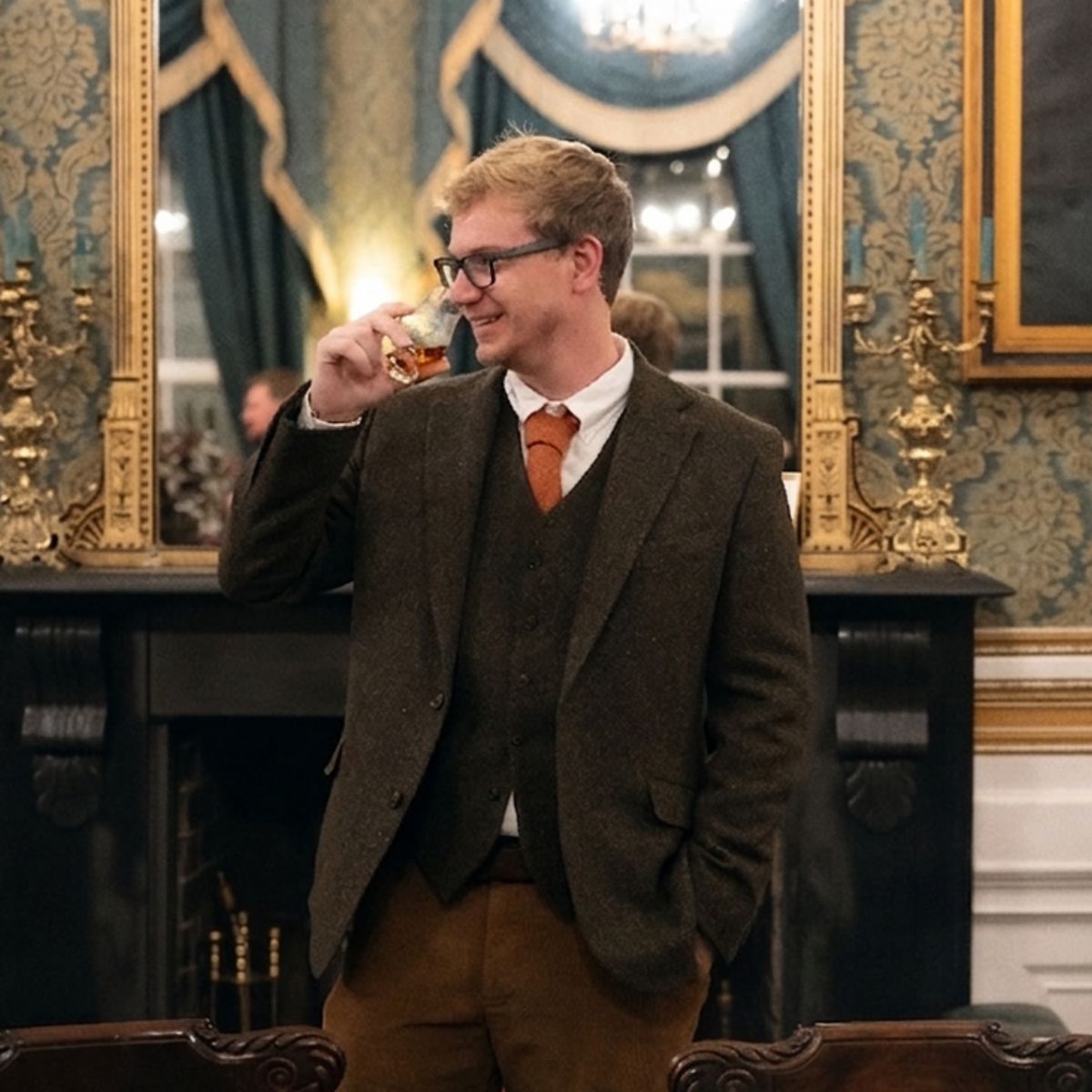
Now that I’ve written ten of these newsletters, I figured I could go back to another opt-ed. This is to step away from the traditional newsletters this week and give us a nice little emotional break. We can doom and gloom next week.
This might be best enjoyed with a dram, so if you’re reading this in the morning, I’m sorry. Maybe revisit it tonight. I also wish I could transcribe this into audio, as I feel that could be a great way to interact. Let me look into that, actually! Anyways, With that, let's dive in.
A LOVE LETTER TO SCOTCH Somewhere between Edinburgh and the edge of the world, I found what I was looking for.

From my trip in 2024
There's something just so magical when you first step out of the train at Waverley Station in Edinburgh. Whether you fly into Edinburgh Airport, or train down from Glasgow or up from London, arriving into the city center feels like stepping through a door that was left open by accident, one that leads somewhere time forgot to close. Buildings rise that look as if the Knights Templar are about to exit, and they once probably did from those very same doors. The roads are cobblestone, eroded from centuries of use, worn smooth by the weight of everything that has ever mattered here. Everywhere you look, you see "Scotch Whisky" signs, or stores selling hundreds of brands, some you and I have never heard of. You walk down the Royal Mile, gawking at the sheer amount of wool. The Barbour stores call your name. Royal Mile Whiskies looks like a candy shop with a velvet rope. St. Giles' Cathedral looms over the Mile, with hundreds of tourists snapping photos in every language on earth.
You turn down Victoria Street to find that first pint, and the brightly colored row of buildings curves steeply to the left. People walk past you in black cloaks, lined inside with red, green, yellow, or blue, because yes, this is the birthplace of the Chosen One. Just before the curve on the left, you find what you are looking for. The Bow Bar. Dark wood, no music, a wall of bottles behind the bar that amounts to an education, a love letter written in glass. You pull up a stool, order a pint of cask ale, and let Edinburgh wash over you like something you have always known but never had the words for.
But Edinburgh, as magnificent and ancient and theatrical as it is, is not where this story ends.
This story ends, and begins again, 140 miles to the southwest.
The Road There
If you are going to make a pilgrimage, you should feel it in your body. Edinburgh to Campbeltown is not a flight. It is not a motorway. It is Scotland refusing to let you arrive without first earning it, insisting that you sit with the beauty long enough to understand what you are about to receive.
You leave the city heading west, and the urban fabric falls away faster than you expect. By the time you clear Glasgow, you pick up the A82 along the western shore of Loch Lomond, and the landscape begins its argument with you. The loch stretches wide and grey-green to your right, the hills rising steeply on the far bank, their reflections dissolving into the water below. You are not in a hurry. You cannot be. Scotland will not allow it.
At Tarbet, you leave Loch Lomond behind and join the A83, which will carry you the rest of the way. The road is nearly 100 miles long, running almost entirely through some of the most beautiful countryside Scotland has to offer, and it earns that description without announcing it. The road does not perform. It simply is.
From Tarbet the A83 runs west across the watershed between Loch Lomond and Loch Long to Arrochar, then turns northwest through the Rest and Be Thankful mountain pass through Glen Croe in the Arrochar Alps. The climb through Glen Croe is steep and slow and stunning. The road crosses and re-crosses the river in the crag-confined floor of the glen before climbing steadily up the valley flank to the head of the pass. There are no guardrails on much of it. There are no shoulders. There is only the road, and the mountain pressing in from both sides, and the vertical drop just past your left elbow that you are trying very hard not to think about.
And then you reach the top.
At 245 meters above sea level, the pass divides Glen Kinglas from Glen Croe. Soldiers from the 24th Regiment completed the road over the summit in the 18th century and erected a stone seat inscribed with the words: "Rest and Be Thankful." They meant it. You will too. Pull over. Stand in the wind. Look at what Scotland has done with its geology and its light, how it has taken raw, difficult, uncompromising material and made something that stops you cold and holds you there. Understand that you are not in a hurry.
Then descend toward Loch Fyne, through Inveraray, past the castle with its fairytale turrets rising improbably from the shoreline. Continue south. The road narrows as you push deeper into Kintyre. The peninsula tightens around you like a confidence, something shared between the land and the sea and you, specifically you, for having come this far. The Atlantic appears to the west in glimpses between the hills, grey and enormous and indifferent, and on a clear day Islay and Jura sit on the horizon. If you know anything about whisky, this will do something to you.
The towns thin out. The road thins out. The signs for Campbeltown appear, and then disappear, and then appear again, closer now. You drive through a landscape that has been doing exactly what it has always done, long before anyone built a road through it, long before anyone thought to ferment grain and call it civilization.
And then, at the very bottom of the world, Campbeltown.
The Last Whisky Town
The Scotch whisky landscape of the 17th and 18th centuries was built on smuggling. Taxes imposed by Parliament in 1644 drove the trade underground, and for the next 150 years, illegal distillation was the industry. Campbeltown was its beating heart. The town sits at the end of a peninsula with easy sea access to Glasgow and a local coal supply that made production cheap and shipping cheaper. At its peak, more than thirty distilleries operated within its limits. The town smelled of malt and sea salt and wood smoke constantly, a permanent, glorious fog of fermentation and ambition. The Victorian distilling historian Alfred Barnard toured 21 of them in 1885 and called Campbeltown "Whisky City."
Then the markets shifted. The world wars came. Prohibition strangled the American export trade. Some distilleries cut corners to survive, flooding the market with inferior spirit and dragging the region's reputation into the ground with them. One by one the lights went out. By the mid-twentieth century, a town that had once been the center of the whisky world was down to a single operating distillery.
That distillery was Springbank.
The Mitchell family's connection to distilling in Campbeltown runs back to the 1660s, when they arrived from the Scottish Lowlands, already involved in the trade. By the early 1800s, Archibald Mitchell was a partner in the illegal Rieclachan Distillery, and in 1828 he and his brother Hugh did something brave: they went legitimate. They built Springbank on the exact site of Archibald's formerly illicit still. The same ground. The same family. The same fire, just with a license now.
In 1837 the Reid family, who had initially held the licensed title, ran into financial difficulties and sold to John and William Mitchell. It has not left the family since. J&A Mitchell Co. was founded in 1897, and the company's current owner and chairman is Hedley Wright, great-great-grandson of Archibald Mitchell. Nearly two centuries of unbroken family ownership, through every industry collapse, every wave of consolidation, every economic argument for selling. They never did. Some things are not for sale. Some families understand that.
Springbank is the one of the only Scottish distillery to floor malt all the barley it requires. It is the only truly estate-bottled malt in Scotland. Every shortcut available to them, they declined to take. Not as a marketing position. As a conviction.
When you pull up to the distillery for the first time, the clock tower of Glengyle sits in the background, the same one that graces the Kilkerran labels. Hedley Wright revived Glengyle in 2000, and it came back to life in 2004, the first new whisky-making facility in Campbeltown in over 125 years. It felt, to everyone in the town, like something returning to where it belonged.
And then you walk through the gates of Springbank itself, and you understand immediately that this place does not care what you were expecting.
What It Looks Like
It is old. Genuinely, unselfconsciously, magnificently old.
Not restored-to-look-old. Not heritage-branded-old. Just old, in the way that a tool used every single day for two hundred years is old: worn down exactly where it should be, bearing the marks of every hand that has touched it, still completely functional, still absolutely itself. The buildings are shades of brown and white. The walls are thick. The doors are low. The floors are uneven.
There is just a distillery. A real one. One of the rawest you will ever see, and one of the most honest.
It smells of malt and peat before you are even properly inside. The oak and the ferment hang in the air like a welcome, like something waiting for you specifically, like a letter addressed to no one in particular that somehow has your name on it. By the time our guide, Finley, an older gentleman who moved through the place with the easy authority of someone who has known every corner of it for decades, led us into the malting floors, the smell had become something close to a physical presence. You breathe it in and it stays with you.
On those malting floors, you can turn the barley by hand. We did. The grain gives under the wooden rake with a soft resistance, releasing heat from the germination below. It is warm, alive, working. Springbank still floor malts its own barley on site, one of the only distilleries in Scotland that does. It is not theater. It is not tradition for tradition's sake. It is the reason the whisky tastes the way it does, and they know it, and they keep doing it, because some things are worth the extra effort, and you know that when you hold them.
Finley kept us moving, winding through spaces barely wide enough for one person, ducking under pipes, squeezing past equipment that has been running longer than any of us have been alive. He made light of it all. He had the specific kind of humor that belongs to people who are deeply expert and have nothing left to prove: gentle, unhurried, quietly in love with where they are.
The Process
Springbank does something almost no one else does anymore. They control the entire production process themselves, from barley to bottle. That phrase is not for show. It is a literal description of what happens within those walls, an act of sustained devotion that most of the industry abandoned decades ago.
The barley is malted on site. Dried over a peat fire, giving the spirit its characteristic smoke, which sits at a gentler register than the fierce, medicinal peat of Islay, more a suggestion than a demand. It is mashed and fermented in wooden washbacks, where the yeast works through long, slow fermentations that build complexity unavailable to faster processes. The wash is distilled two and a half times, a number unique to Springbank, neither the double distillation of most Scotch nor the triple distillation of Irish whiskey, but something in between, something of its own invention, its own private logic.
The spirit goes into casks and disappears into the dunnage warehouses. Low, stone-floored, cool, dark. The casks sit directly on the earth. The angel's share climbs slowly into the Kintyre air. And then you wait. Years. Decades. An entire shelf life of patience, which is perhaps the most romantic thing a person or a place can offer.
Doug, who handled the blending and bottling session that concluded the day, had the unhurried ease of a man who understands time differently than the rest of us. His marmalade, offered during the session and at the gift shop, was absurdly good, a detail that felt entirely consistent with a place that does everything itself and does it with genuine care.
What We Tasted
In the warehouses, we pulled samples from casks that people would only dream of.
A Hazelburn 24-year-old, all softness and dried fruit, the triple-distilled unpeated expression transformed by its own character and two decades of patient sleep. A Longrow 28-year-old from the heavily peated expression, maritime and ancient and quiet, the way something that has seen everything can finally afford to be quiet. And then: a Springbank 32-year-old, distilled in 1990, drawn from a refill bourbon hogshead, bottled at 41.6%.
I will not insult it with tasting notes.
I will say only that thirty-two years of patience, in a stone warehouse on the edge of the Atlantic, produce something that no column still and no industrial process will ever approximate. You taste it and you understand, in a way that bypasses language entirely, why someone refused to close this place no matter what. Why the family held on. Why the town held on. Some things taste like the reason.
The blending session followed. You sit at a table with small samples drawn from different casks: first fill bourbon, refill Sauternes, port, rum, sherry, each with its own story, each a piece of what Springbank can become when you ask it to. You blend your own bottle in whatever proportions make sense to you, and you seal it, and you take it home, and it is yours in a way that no bottle purchased from a shelf will ever quite be. It carries your fingerprints, your choices, your particular afternoon in a distillery at the end of the world.
What Scotland Tastes Like
If Islay is why I love Scotch, the reason I first fell, the peat smoke and salt spray and iodine that rewired something in my brain years ago and never let it go, then Springbank is what I love it for. The difference is not small.
Islay taught me the vocabulary. Springbank gave me the emotion.
It tastes like slight peat and vanilla and oak and honey, and underneath all of that there is something the industry calls "funk," a word that fails entirely to capture what it actually is. It is the taste of a place. The taste of a process done slowly and honestly by people who are not optimizing for margin. It is the taste of the floor malt and the wooden washbacks and the stone warehouse and the Atlantic air and thirty-two years of patience and a family that refused to sell.
I did not open my blending bottle when I got home.
I opened it the night before my wedding. In Scotland, where it was made, where I had made it with my own hands on a quiet afternoon with Doug and Finley and my now father-in-law. I poured it, and I sat with it, and I thought about the fact that the next day I would make a promise in front of everyone I love, and that this bottle, this specific and unrepeatable bottle, had been waiting in the dark for exactly this moment. It didn't know that, of course. But I did.
Springbank tastes like things worth keeping. Like decisions made slowly, with care, by people who understood what they were committing to. It tastes like something that doesn't need to announce itself, because it already knows what it is.
Some love letters are better unread, kept in the envelope, in the drawer, proof that the feeling happened.
Some you open the night before everything changes.
Go to Campbeltown. Make your bottle. Hold onto it. Then, when the moment arrives, and it will, you'll know.
-Mark
Enjoy some photos! All taken from my bottle to barley tour.

Springbanks Process

Tough work!

Glengyle Clock

Check out this setup!

A new blended bottle! Peep the watch.

This is why I love wearing the same watch to events I capture. I look back in fond memories with my Omega SMP.

Aye, it’s me!

Fun little background worthy photo.
