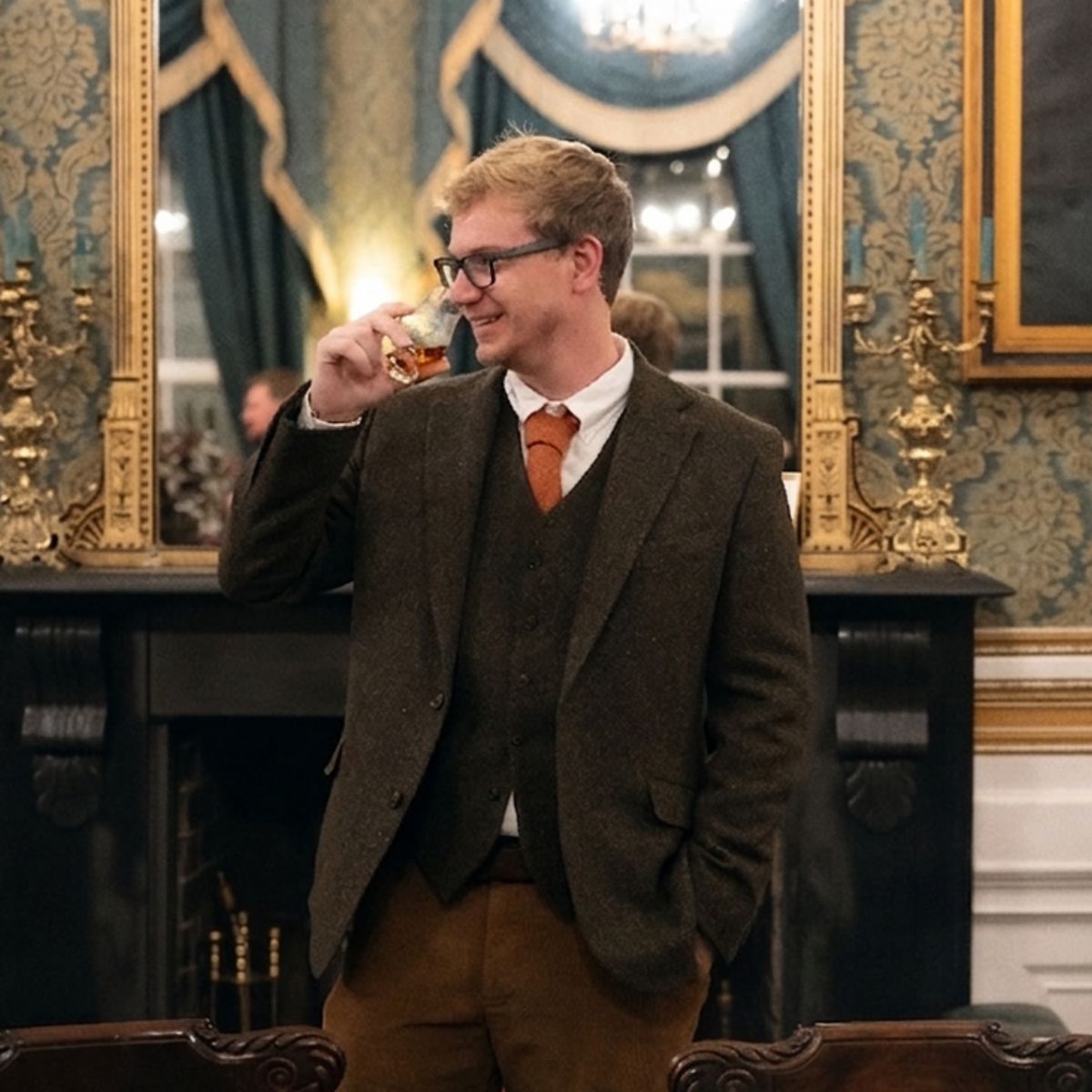

Last issue, I asked you to sit with me through three long-form essays about whisky, watches, and cars. You did. Either that means you genuinely enjoyed it, or you were stuck on a train with no signal and this was your only option. Either way, welcome back. This week we're doing something different. Less therapy session, more newspaper. The industries we love are actually producing news worth talking about, billion-dollar mergers, new distilleries rising from old names, the world's biggest watch fair throwing open its doors, and Ford building a Mustang that apparently has the audacity to challenge a Porsche on track. So pour something, strap something on your wrist, and let's get into it.
POURED. WORN. DRIVEN. -- Issue No. 2
Whisk(e)y
Poured: The Biggest Deal in Bourbon History Isn't Done Yet

Buffalo Trace from my trip in 2021
The American whiskey industry may be on the verge of a seismic realignment. According to a report from The Wall Street Journal, Sazerac has approached Brown-Forman about a potential deal, entering a bidding situation that already includes France's Pernod Ricard. Let that sit for a moment. Two Louisville, Kentucky companies, both pillars of the American whiskey world, potentially merging into something the industry has never seen before. Brown-Forman, home to Jack Daniel's, Woodford Reserve, and Old Forester, is valued at approximately $12.4 billion. Sazerac, meanwhile, privately held by the Goldring family and producing everything from Buffalo Trace to Pappy Van Winkle to W.L. Weller, is estimated to be worth close to $10 billion. Combined, you're talking about a company valued north of $22 billion just on those two alone. A full union would create a group worth more than $35 billion, positioning it as a direct rival to Diageo, which is currently valued at more than $40 billion. Diageo's roster includes Johnnie Walker, Guinness, Talisker, Lagavulin, Caol Ila, Don Julio, Bulleit, and George Dickel, among hundreds of others. This merger would put an American company in legitimate contention for that throne.
The combined portfolio would be staggering. From Brown-Forman's side: Jack Daniel's and its full family of expressions, Woodford Reserve, Old Forester, el Jimador tequila, Herradura tequila, Diplomático Rum, Gin Mare, Fords Gin, Chambord, Slane Irish Whiskey, and New Mix RTDs. Also notably, the three Scotch distilleries Brown-Forman acquired in 2016 for approximately £285 million: The GlenDronach, BenRiach, and Glenglassaugh, three Highland and Speyside distilleries with serious collector credibility. Sazerac manages a portfolio of around 550 brands, including Buffalo Trace, Fireball Cinnamon Whisky, BuzzBallz ready-to-drink cocktails, Sazerac Rye, Paul Masson brandy, Svedka Vodka, Myer's Rum, Corazón Tequila, and Southern Comfort. That's not a company. That's an empire. And it raises real questions for collectors and enthusiasts about what consolidation at this scale means for the independence, quality, and allocation strategies of the labels we actually care about.

Old Forestor Brown-Forman Building from my trip in 2021
Brown-Forman is looking for a potential sale or merger due to slowing sales and intense competition in a challenging economic environment for whiskey. The company has experienced declining sales in recent years, with its shares falling since late 2020 and the company heading toward a third consecutive year of revenue decline. Canada's retaliatory ban on American spirits didn't help, either. Brown-Forman reported stagnant sales in the nine months to January 2026, as Canada's year-long ban on US alcohol significantly impacted revenue. The Pernod Ricard option would have been transformative in a different way, an international merger creating a global powerhouse combining Chivas Regal, The Glenlivet, Jameson, Absolut, and Champagne brands with Brown-Forman's American whiskey depth. The Sazerac play is more concentrated, more American-focused, and arguably more dangerous from a market competition standpoint. A combination of the two would see them account for an 18% share of the US market and nearly 40% of American whiskey, which is precisely the kind of figure that triggers antitrust scrutiny. However this shakes out, the whiskey world will not look the same on the other side of it.
Review Time
Benromach Distillery Exclusive

Benromach Distillery Exclusive 19yo, First Fill Virgin Oak Cask, 58.7%
Nose: Slight peat, spice, funky industrial, but spice really comes through. Fresh dark fruit. Vanilla.
Palate: Spice really plays here. Peat pokes in. Oaky. Great mouth feel. Oily.
Finish: Spice and spice. Oak comes through right at the end. Peat stays around long after you finish.
There is a short list of distilleries that genuinely change the way you think about Scotch whisky. Not just bottles you enjoyed, but places whose entire philosophy rearranges something in your brain about what the spirit can be. Benromach is at the top of that list for me, and it has been for a while. Tucked just off the A96 in Forres, Speyside, it is a small, almost deceptively modest operation, bought silent and dormant by independent bottler Gordon and MacPhail in 1993 after spending a decade mothballed, and brought back to life in 1998. What G&M rebuilt was not just a distillery but a specific idea about whisky: small scale, lightly peated, unhurried, and honest. Twenty-something years later, the liquid coming out of those warehouses is making a case that patience is the most underrated ingredient in this industry. Cask No. 358 is nineteen years old, first fill virgin oak, 279 bottles, and 58.7% ABV. It is the kind of number that makes you sit up straight before you've even poured it.
The Goods: Benromach Distillery Exclusive, First Fill Virgin Oak Single Cask | Cask No. 358 | 1 of 279 Bottles
Age | 19yo |
|---|---|
ABV | 58.7% |
Cask Type | First Fill Virgin Oak |
Color/Filtered | Natural Color - Non-Chill Filtered |
Price | 120 gbp (~$160 day depending) |
Where to buy | Distillery Only. Sorry. |
Score | 8.9/10 |
Watches
Worn: Geneva Showed Up. The Watches Mostly Didn't.

Watches and Wonders 2026 is officially in the books, and I'll be honest with you: it was a disappointment. Not a disaster, not a catastrophe, just a quiet, collective shrug from an industry that had every opportunity to swing big and largely chose not to. With 65 brands on the floor and nearly 60,000 visitors descending on Geneva, the expectation is always that someone, somewhere, is going to do something that makes you put your coffee down. This year, almost nobody did. The big houses played it safe. The Holy Trinity delivered refinements where they should have delivered revelations. Switzerland is not a cheap place to run a watch fair, and if the brands showing up are going to phone it in, you have to wonder what the exercise is actually for.

There were exceptions. Vacheron Constantin showed the Overseas Dual Time in a deep forest green that is genuinely difficult to argue with, all monochromatic dial, orange AM/PM indicator, canvas strap, and that unmistakable integrated case doing exactly what it does best. At around $41,000 it is not an impulse buy, but it is one of the few pieces from this year's show that felt like it had a point of view. It's the kind of watch that rewards you for looking at it twice. That's rarer than it should be at an event of this scale.

Then there's the piece that actually truly excited me, and I would buy in a heartbeat (and… in theory “could” but I “SHOULD NOT”). Frédérique Constant, not a brand you typically expect to lead the conversation at the most prestigious watch fair in the world, came in with a Worldtimer that looked like someone had captured the ocean from altitude and pressed it flat under a sapphire crystal. The deep blue aventurine style dial with the continental landmasses floating across the surface has no right being this evocative at a $5,000 price point. It looks like standing water. It looks like the Atlantic at two in the morning from a window seat. It is the kind of dial that makes you stop and think about what the major houses are actually spending their development budgets on, because a brand operating at a fraction of the price just out-dialed most of them. When an entry-level luxury worldtimer is one of the most visually arresting things on the floor, the conversation about value in this industry needs to happen sooner rather than later.

And then there is the Cartier. The Tortue Panthère Métiers d'Art is the kind of watch that makes the rest of the fair feel like a warm-up act. The Tortue case, first created in 1912, has always been one of the more quietly elegant shapes in Cartier's arsenal, and here they have used it as a canvas for something that operates in an entirely different register from everything else shown this week. The dial and case middle are covered in champlevé enamel depicting the Panthère, Cartier's iconic feline, gazing out from behind a curtain of falling rain. Over 15 tones per piece. More than 36 separate firings. 80 hours to enamel the dial. Another 50 for the case. Three hours just to set the emerald eyes. One hundred and thirty-three hours of hand craftsmanship on a single watch, and it shows in the way that only truly obsessive work shows, which is to say it looks effortless. The enamel extends without interruption from the dial surface across the case middle, creating a single unified image that wraps the entire watch. It is produced in two limited editions of 100 pieces each. At press time, the brand declined to release pricing ahead of the official announcement. You already know. If you have to ask, the answer is no. But what a thing to say no to.
If you do not know Frederique Constant, you should. They’re one of my favorite affordable Swiss brands. If you do not have one, take a look. Their Healey collection is great! I love mine.
Also, if you’re interested, here are the rest of my coverage from Watches and Wonder 2026! It will continue all this week, into next, so be on the lookout!
Wheels
Driven: New York Fired a Shot. Detroit Should Be Paying Attention.

The 2026 New York International Auto Show wrapped last week, and for all the hand-wringing about shrinking attendance rosters, the show still managed to deliver a few proper moments. The floor had its notable absences: no Honda, Acura, Mazda, or Lexus, and the German brands largely phoned it in with small displays in back corners. But what was there mattered. Hyundai brought a body-on-frame truck concept that signals serious long-term ambitions. The 2027 Corvette Grand Sport debuted a new 6.7-liter V8 making 535 hp, and the HEMI V8 made its return to the Ram 1500 after customer backlash forced Stellantis back to what buyers actually wanted. Good to see the industry occasionally listening to the people spending the money.

Mustang Dark Horse SC. $108,500-$176,000
The car that cut through everything else, though, was Ford's Mustang Dark Horse SC. The Dark Horse SC is the spiritual and mechanical successor to the S550 Shelby GT500, bridging the gap between the standard Dark Horse and the unobtainable GTD. Note the absence of Carroll Shelby's name, which is intentional: Ford has been actively rebranding Ford Performance as Ford Racing to emphasize a direct technical lineage between their GT3/GT4 programs and their road cars. Under the hood is the supercharged 5.2-liter Predator V8, the same engine family that lived in the old GT500, and while Ford hasn't confirmed final output, the Dark Horse SC makes well over 700 horsepower. The optional Track Pack sheds 120 pounds of unsprung weight via carbon-fiber wheels and Brembo carbon-ceramic brakes, 3D-printed titanium accents sourced from the GTD program, and a new aluminum hood with a massive vent. With the hood vent tray removed it creates 2.5 times the downforce, and the Track Pack's carbon-fiber wing generates 620 pounds of rear downforce at 180 mph. The pricing puts it in six-figure territory, squarely aimed at the Porsche 911 GT3 and BMW M4 CS, and Ford's Mustang brand manager apparently said, without blinking, that they designed it to beat them. Whether that's true will be sorted on track. But the intention is right.

The harder conversation is the one happening just outside the showroom, and is the talk of the industry. The Trump administration tariffs on imported vehicles and auto parts have cost automakers a staggering $35.4 billion since their implementation in 2025. Toyota has been the hardest hit, projecting $9.1 billion in tariff-related costs for the fiscal year ending March 2026, while the three major Detroit automakers collectively incurred $6.5 billion in costs in 2025. The ripple effects are already showing up at the sticker. The average new vehicle transaction price hit $49,275 in March 2026, up 3.5% year over year, marking the fourth consecutive month of accelerating annual price gains. Toyota is perhaps the most vivid example of the pressure, swapping CEOs in February and replacing Koji Sato with CFO Kenta Kon effective April 1, a move widely read as a signal that financial discipline and tariff management would now drive the company's strategy. Toyota told CNBC in no uncertain terms that the tariffs are "highly disruptive" and "cannot be sustained." The company is now projecting three price increases throughout 2026 instead of the usual two, and Volvo has already announced 3,000 job cuts globally as part of a $1.89 billion cost-reduction effort. The performance cars are getting better. The average car is getting more expensive. Both things are true at the same time, and it matters.
Why this matters: The average new vehicle transaction price hit $49,275 in March 2026, up 3.5% year over year, marking the fourth consecutive month of accelerating annual price gains. That's not an industry statistic. That's money coming directly out of your pocket the next time you're on a lot.
What this means: The brands absorbing the most pain are the ones who build outside the US and sell inside it. Toyota, Volvo, and the European luxury houses are all staring down a cost structure that no longer makes sense. Volvo has already announced 3,000 job cuts globally as part of a $1.89 billion cost-reduction effort. Toyota is projecting three price increases in 2026 instead of the usual two. The math is breaking, and consumers will feel it before the boardrooms do. It’s also not that simple to move and start making in the US. It takes billions and about a decade.
What’s next: The USMCA trade agreement is up for review in July, and the outcome will determine whether automakers can commit to new US production investments or continue absorbing losses quarter by quarter. Toyota is already running its American factories at full capacity. The question isn't whether prices go up. It's how far, and how fast.
Final Thoughts: Good luck buying a new car. As someone who wants one, it’s tough. This also means maintaining your car is through the roof, since parts (and labor) have gone up. Cars are one thing that people must buy, so how far can we all go?
That's Issue No. 2. Whisky empires, a watch that took 133 hours to make and approximately four seconds to fall in love with, a Mustang with more downforce than excuses, and a tariff situation that is nobody's friend except the used car market. If you made it this far, you are my kind of person and I am genuinely sorry about your whisky/watch budget. I get them all… Like Tim and Dan buying so many watches. Sorry guys. Forward this to someone who understands why all three of these things belong in the same place. They exist. You know exactly who they are. Forward it enough times and maybe I can afford that Cartier. We're going to need a lot of forwards. See you next issue.
Poured. Worn. Driven.
Wristmas & The W’s
